"[History is] a cyclic poem written by time upon the memories of man." -Percy Bysshe Shelley

Tuesday, July 3, 2012

A look back: the 19th century and earlier

Having unearthed another article by Michael J. Dunn, III, on the history of Manitowish Waters, I think it's appropriate to share most of it on this blog. I will, of course, split the content over multiple posts!

The Lake Superior Chippewa [Ojibwe] Indians were the first people to leave a significant imprint on this region. The Chippewa people had moved westward along the Great Lakes in quest of better hunting during the 1600's and 1700's, had become involved in the fur trade with Europeans and had come to depend on [European] trade goods, like guns, iron vessels, woven fabric, even whiskey. They were now venturing farther and farther inland from the Lake Superior shoreline to find supplies of fur-bearing animals to meet their trading needs. Between 1700 and 1750 they had routed the Sioux [their sometime rivals] and had established .... a settlement at Lac du Flambeau.
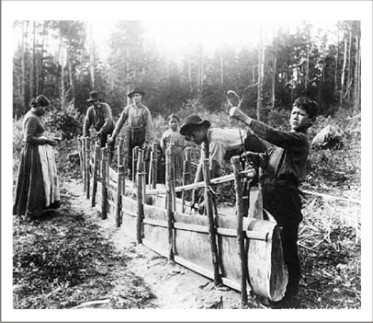
Native people building a birch bark canoe
Their traditional lifestyle was a cycle of moves with the seasons of the year: in spring they made sugar in their maple-sugaring grounds. In summer they moved on to their fishing grounds, where they fished for present sustenance and dried fish for later use, planted and harvested corn, and picked and preserved berries. In late summer they progressed to their wild ricing grounds, and in fall they moved on to their hunting grounds.

They traveled in birchbark canoes and when they stayed any length of time, they covered sapling frameworks with birchbark to make wigwam-style homes, rolling up the precious bark and taking it with them when they moved on.

In the waning decades of the 1800's, though, the Chippewas were playing out the final years of this drama, perhaps without realizing it at the time, for the later 1800's would see a movement to cluster them all on their government sponsored reservation at Flambeau and settle them there.

Until then, however, some of the Chippewas had a favorite encampment spot on the east shore of Manitowish Lake where Deer Park Lodge was later developed, and here they camped, fished and even buried some of their dead. They also gathered wild rice not far away up near Big Lake, which they were able to reach by canoe via Island Lake and Rice Creek, and they continued to gather rice there into the 1900's, well after they had ceased camping on Manitowish Lake. (Their impact upon the area is evident in the fact that Manitowish Lake is almost the only body of water labeled by name on the map made by the first surveyors in the 1860's. Manitowish is the word for weasel or muskrat* in the dictionary of Chippewa language that Father Baraga compiled and published during his long career as a missionary among the Lake Superior Chippewa in the mid-1800s.)

Government surveyors were the first [Europeans] who left a record of their passing through the area we know as Manitowish Waters; one party passed by as it established the boundaries for townships in 1860 and a second party crisscrossed the township in 1862, establishing interior section lines. They made systematic notes, and these notes acknowledge the valuable timber resources here and even note the fact that the logs could be floated down rivers to sawmills elsewhere. By 1872 people were putting in applications for lands near the chain of lakes and by the 1800s [?] the lumber people were jockeying in earnest for control of large timber tracts.

By 1884, if we can rely on Peter Vance, one of the participants, a little flotilla of canoes paddled up the Manitowish River from Eau Claire-Chippewa Falls area[.]

They were sent to evaluate, or "cruise," the woods for timber and help plan the assault on the white pine forests, and their arrival also established a permanent white presence in township 42 North, Range 5 East: the present Manitowish Waters. The 1800's also brought [pioneers] who were not directly involved with this timber cruising.

What the lumbermen found -- and coveted -- were virgin forest so tall and thick that while they still stood uncut, a person could walk six miles downstream from the present dam toward Manitowish, on the little road that developed parallel to the river, and never leave total shade for direst sunlight!

In contrast, when all the loggers were done, twenty-five years later, a person could stand, say, at Boulder Junction, and could see all the way across the logging and fire-ravaged landscape to Trout Lake or almost to the Manitowish chain.

A little rapids formed a threshold for the chain of lakes. In 1887 the state legislature authorized the lumbermen to build a dam there to pen up waters of the chain for logging and river driving. In 1887-88 crews built a camp below the dam site and began freighting in the first supplies upriver from the railroad at Fifield and Park Falls. They also began grading the earthworks on either bank and began building rock crib and timber dam tall and strong enough to hold back water fifteen feet deeper than the chain had ever seen before!

White pine was valued for its fine lumber, but besides that, it was light enough to float infinitely, and logs put into the water on the Manitowish chain could certainly stay afloat long enough to reach mills almost 200 miles away at Chippewa Falls or Eau Claire. So crews began cutting the pines in winter and putting the logs into the swollen lakes at break-up; and paddle-wheel steamboat herded them to the dam end or Rest Lake from all around the chain.

*Another translation of Manitowish might be "playful spirit" -- perhaps more otter than weasel! [C.B.]

to frighten an angel or intimidate a Caesar

A final excerpt from Malhiot's journal, written during his time at the fort in Lac du Flambeau. If Malhiot felt that Flambeau Lake was "worthier of the name of swamp," I can only imagine that he would have felt much the same about the Manitowish Waters chain!

Voyageurs at Dawn, Frances Ann Hopkins, 1871
[O]f all the spots and places I have seen in my thirteen years’ of travels, this is the most horrid and most sterile. The Portage road is truly that to heaven because it is narrow, full of overturned trees, obstacles, thorns, and muskegs. Men who go over it loaded and who are obliged to carry baggage over it, certainly deserve to be called “men.”

This vile portage is inhabited solely by owls, because no other animal could find a living there, and the hoots of those solitary birds are enough to frighten an angel or intimidate a Caesar.

As to Lac du Flambeau it is worthier of the name of swamp than of lake and at this season it would be easier to catch bullfrogs in the nets than fish. I have had the nets set three times since my arrival without catching a fish. Today I am sending Gauthier to cast his nets in another lake; perhaps we shall get some crawfish. With regard to the river I will never call it anything but a small stream, because in many places a mouse could cross it without wetting its belly. All the Savages I have seen so far seemed to me to be good providers; another time, when I shall have seen them all, I will speak of them more at length.
Next time you hop on your pontoon or climb in a canoe, think of those wiry Voyageurs paddling across the lakes and struggling on the narrow portage trails in between, carrying 90 pounds of gear. Monsieur Malhiot, suffering from toothache. The so-called Savages, whose culture we have at last learned to respect. The 200 years that separate us is not, in the scheme of things, so very far. It certainly puts our lifestyles in perspective!

Thursday, June 21, 2012

visit the past

Intrigued by the idea of what it might have been like to live at the time of Malhiot and others? Check out impressive Fort William in Thunder Bay, Ontario, where the original North West Company trading post has been recreated and is alive with reenactors and historically accurate surroundings!


Malhiot's arrival in Lac du Flambeau

Ever wonder what it might be like to travel to our area 200+ years ago? Read on for Francois Victor Malhiot's account of his journey to Lac du Flambeau in July 1804.


Quetico Superior route, passing a waterfall, Frances Anne Hopkins
Hopkins painted herself into some of her pieces -- see her in the middle wearing a blue hat
Keep in mind that just getting to La Pointe was a journey in itself, requiring Malhiot to traverse Lake Superior. He started out from Kaministiquia, now known as Fort William, in present-day Ontario. It took him 11 days to reach La Pointe on Madeline Island, and several more to reach the mouth of the Bad River, where he begins the following journal entry:
27th Friday. Our people from Lac du Flambeau, Tremble Martineau, and Le Beau, arrived here at six o’clock yesterday evening with their baggage, decided to go on to Mr Cadotte at la Pointe if they had not found another clerk to replace Gauthier.

They are thin and emaciated like real skeletons. They say they were more ill-treated than ever by Gauthier; that half the time they had nothing to eat, while he is resolved to go and work for the XY if he is replaced by another; further, that he has sworn to kill Raciot for having written against him, and that there would be murder before he left Lac du Flambeau; that he is resolved to pull up all the clearings, that is to say the potatoes and corn he had planted or caused to be planted; finally, that he is like a wild beast, and not a day passes without his swearing, storming, and inveighing against those who wintered with him last year. He has got only three packs of furs at the most, besides one he traded for his own goods.

I will not undertake the portage today because these men from the interior aska day’s rest. How weak they are!! I gave each of them a drink of shrub, two double handfuls of flour, and two pounds of pork and they began to eat with such avidity that I was twice obliged to take the dish away from them, and, notwithstanding this, I feared for a long while that injurious consequences would result; fortunately they all escaped with slight twinges of colic.

28th Saturday. I started this morning from Lake Superior with seven of my men to proceed at once to Lac du Flambeau. I took with me a bale of merchandize, a roll of tobacco, 20 pounds of shot, 20 pounds of bullets, three quarters of a sack of corn, a barrel of rum double strength, and all my baggage. Today we did forty pauses. I left the remainder of my things under the care and charge of Racicot. Durocher, who has been poisoned with poison-ivy, is also with him; otherwise he would have come with me with a load. My toothache is beginning again as bad as ever. I gave my people a small drink of shrub.

29th Sunday. Today we did only 20 pauses because I suffered too much from my toothache last night, and had to get my head sweated this morning which soothed the pain a little. It is now 4 o’clock in the afternoon and we are camping because several of the men are complaining greatly of pains in their legs and it is necessary to spare them. My toothache is a little better than it was in the morning. I feel weak at times, owing to my being unable to take any food. I gave my men a drink of shrub.

31st Tuesday. We started at seven o’clock this morning and at last, at one o’clock in the afternoon, we reached the end of the Portage; the people were somewhat tired, and Bourbon had severe pains in his legs. I sent them at once to get the canoes that were cached, to have them gummed, and I made them make paddles so as to be able to start tomorrow morning.
August 2nd Thursday. I started at 4 o’clock this morning and arrived here at Fort du Flambeau at 3 o’clock in the afternoon. I found Gauthier quite disconcerted, trembling, and not knowing what to say. I read him the letter from Mr William McGillivray which frightened him still more and made him shed tears. I gave him all the messages from Mr McGillivray and Mr Sayer, remonstrated with him in every way, after which he admitted his errors.

Malhiot's journal is sourced from Digital Time Travelers.

a glimpse into Manitowish Waters during the fur trade

Most of us are familiar with the Voyageurs, those intrepid French and French Canadians who traversed most of North America by canoes that they carried on their shoulders over long-distance portages. From the late 1600s to the 1800s, the "fur trade" boomed in North America and depended on these hardy men to see it through.
Shooting the Rapids, Frances Anne Hopkins
A Voyageur canoe in action!
Wisconsin, ribboned by rivers and fronting Lake Superior, formed an important part of the route. Place names reflect their presence -- Jacques Marquette being the most famous for having founded Sault Ste. Marie in Michigan/Ontario. On the Bayfield Peninsula's Madeline Island (so named by the French), the town La Pointe was the main route by which the Voyageurs accessed the interior of northern Wisconsin, taking "la Mauvaise riviere" (the Bad River) down to none other than Lac du Flambeau. Seen from this perspective, it is perhaps no surprise that the resort area of Manitowish Waters/Spider Lake once belonged to the Lac du Flambeau township.

In the winter of 1804-05, Francois Victor Malhiot was sent to Lac du Flambeau to investigate the complaints of the local clerk, Charles Gauthier.

Malhiot's journal survives. Complete with references to "the Savages" and unending complaint of toothache (we must remind ourselves that 19th century dental care left something to be desired), it is a fascinating document reflecting the concerns of the time. Read the complete document at Digital Time Traveler, or peruse some excerpts below and to follow.

A little background on Malhiot, from the footnotes:

Francois Victor Malhiot was a French-Canadian of good family, the "son of a respectable gentleman, rich in sentiment and honor." Two of his brothers were known in the service of their country-Lieut.-Col. Pierre Ignace Malhiot, who entered the army and served in Canada, and Hon. Xavier Malhiot, representative in the Canadian parliament, who died at Boucherville in 1855. Francois was born in 1776, being scarcely fifteen years of age when he became an articled clerk to the North West Company. At the time of Malhiot apprenticeship, the young clerks were required to serve five years for their expenses and £100. Since Malhiot speaks of thirteen years of traveling and eleven years of wintering, it is possible that he spent two years in coming to the upper country for the summers only, serving in the Montreal house during the winters. It is probable that his experiences were in many ways comparable to those of Gurdon Hubbard of Chicago, who has described in his Autobiography the life of a fur-trade apprentice some twenty-five years later (1818-23).

In 1796, Malhiot received his appointment to the upper Red River department, where apparently he remained for eight years, and where in 1799 his annual salary was £240. His was the department of Assiniboine River, which unites with Red River of the North at Winnipeg; and Malhiot was under John MacDonnell, wintering partner of the North West Company (1796-1815). The principal fort was on River Quappelle, with several subsidiary posts. See MacDonnells journal in Masson, Bourgeois, i, pp. 267-295.


At the summer meeting of the partners in 1804, it was decided to promote Malhiot and send him to take charge of a post to the south of Lake Superior [Lac du Flambeau], where complaints of the clerk in charge, Charles Gauthier, seemed of sufficient importance to make some change necessary. Malhiots experiences during the succeeding winter are here related by himself. He repaired and rebuilt the post, and his reports were sufficiently promising to cause his return to the same place for the next year, and apparently for the succeeding one.


In 1807, having become tired of the fur-trade, Malhiot determined to retire, and resigned his position with the company. During his residence in the interior he had, in the fashion of the country, married an Indian woman. This occurred August 8, 1800, at the fort at the mouth of Winnipeg River. See Daniel W. Harmon, Journal of Vayages and Travels (Andover, 1820), p. 49. "This evening," he says, "Mons. Mayotte [Malhiot] took a woman of this country for a wife, or rather concubine." Upon leaving the interior, Malhiot left his Indian wife with her own people, but took with him his half-breed son, Francois Xavier Ignace (named apparently for himself and his own two brothers). Settling at Contrevcoeur he educated his son, and lived there until his death in 1840.

Malhiot was familiarly known to his relatives and intimates as Erambert. He was a cousin of Jacques Porlier of Green Bay, and for a short tie after his return from the Northwest, lived with the latters maiden sisters at Verche`res. He is frequently mentioned in the family letters, and several letters from him to Portlier are in the Wisconsin Historical Library; i.e., Wisconsin MSS., 3B28, 4B52, 13B42, 2C57, 90. ED.

Tuesday, June 19, 2012

Remembering when... Manitowish Waters was in its infancy

More memories of Manitowish Waters in the old days abound, as cataloged by Jean Rein in a July 10, 1998 Lakeland Times article, excerpted below. Inspired by an evening presentation that Ruth Dickerson Gardner gave at the Koller Library, Rein delves into the history of our area.
In 1889 [Ruth] Gardner's great-grandparents Susanne and Henry Levi LaPorte arrived as loggers, settling in Manitowish, near what is now Murray's Landing on the Turtle [Flambeau] Flowage. ...

More important than knowing the chronology of events, Gardner believes, is understanding what life was like during these eras, and feeling the adventurous spirit that brought these people to a rugged wilderness where they worked extremely hard for many years to achieve their dreams. [...]

Thursday, June 14, 2012

history...

Excerpted from "History..." by Michael J. Dunn, III, in an old chamber of commerce booklet. Though  not especially politically correct, this article does contain a few interesting tidbits in "poetical" style -- read on!

The Native Americans apparently visited a site on Manitowish Lake, location unspecified: "The Indians had an age-old gathering place on the eastern shore of Manitowish Lake. Here they met to trade, to distribute funds from Federal paymasters, to bury their dead."

Dunn turns more reliably to "white man history":

The story of early Manitowish Waters rings with the names of colorful settlers and personalities. Abe LaFave, who settled in 1888 and became the predecessor of the resort trade that is now the lifeblood of our community; long gone is the island lodge he built on Island Lake as the first tourist accommodation in the area, but on the shores of that same lake his family today continues the tradition of resort keeping he originated. Dan Devine, who raised a family on Clear Lake, whence he paddled each summer on a month-long canoe journey to Madeline Island in Lake Superior to sell his furs. Peter Vance, a timber cruiser who came here in the 1880s and lies now in our cemetery, his grave marked by a stone recording his hundred years and his pioneer status. Stephan Stewart, once a Yankee soldier in the Civil War, who ... surveyed for a timber company dam[.]