"[History is] a cyclic poem written by time upon the memories of man." -Percy Bysshe Shelley
Showing posts with label history. Show all posts

Tuesday, July 3, 2012

A look back: the 19th century and earlier

Having unearthed another article by Michael J. Dunn, III, on the history of Manitowish Waters, I think it's appropriate to share most of it on this blog. I will, of course, split the content over multiple posts!

The Lake Superior Chippewa [Ojibwe] Indians were the first people to leave a significant imprint on this region. The Chippewa people had moved westward along the Great Lakes in quest of better hunting during the 1600's and 1700's, had become involved in the fur trade with Europeans and had come to depend on [European] trade goods, like guns, iron vessels, woven fabric, even whiskey. They were now venturing farther and farther inland from the Lake Superior shoreline to find supplies of fur-bearing animals to meet their trading needs. Between 1700 and 1750 they had routed the Sioux [their sometime rivals] and had established .... a settlement at Lac du Flambeau.

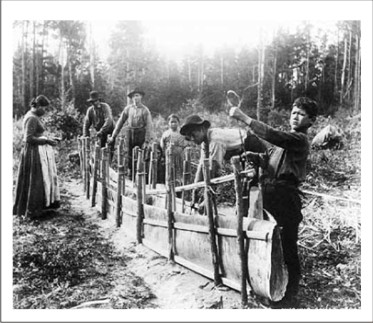
Native people building a birch bark canoe
Their traditional lifestyle was a cycle of moves with the seasons of the year: in spring they made sugar in their maple-sugaring grounds. In summer they moved on to their fishing grounds, where they fished for present sustenance and dried fish for later use, planted and harvested corn, and picked and preserved berries. In late summer they progressed to their wild ricing grounds, and in fall they moved on to their hunting grounds.

They traveled in birchbark canoes and when they stayed any length of time, they covered sapling frameworks with birchbark to make wigwam-style homes, rolling up the precious bark and taking it with them when they moved on.

In the waning decades of the 1800's, though, the Chippewas were playing out the final years of this drama, perhaps without realizing it at the time, for the later 1800's would see a movement to cluster them all on their government sponsored reservation at Flambeau and settle them there.

Until then, however, some of the Chippewas had a favorite encampment spot on the east shore of Manitowish Lake where Deer Park Lodge was later developed, and here they camped, fished and even buried some of their dead. They also gathered wild rice not far away up near Big Lake, which they were able to reach by canoe via Island Lake and Rice Creek, and they continued to gather rice there into the 1900's, well after they had ceased camping on Manitowish Lake. (Their impact upon the area is evident in the fact that Manitowish Lake is almost the only body of water labeled by name on the map made by the first surveyors in the 1860's. Manitowish is the word for weasel or muskrat* in the dictionary of Chippewa language that Father Baraga compiled and published during his long career as a missionary among the Lake Superior Chippewa in the mid-1800s.)

Government surveyors were the first [Europeans] who left a record of their passing through the area we know as Manitowish Waters; one party passed by as it established the boundaries for townships in 1860 and a second party crisscrossed the township in 1862, establishing interior section lines. They made systematic notes, and these notes acknowledge the valuable timber resources here and even note the fact that the logs could be floated down rivers to sawmills elsewhere. By 1872 people were putting in applications for lands near the chain of lakes and by the 1800s [?] the lumber people were jockeying in earnest for control of large timber tracts.

By 1884, if we can rely on Peter Vance, one of the participants, a little flotilla of canoes paddled up the Manitowish River from Eau Claire-Chippewa Falls area[.]

They were sent to evaluate, or "cruise," the woods for timber and help plan the assault on the white pine forests, and their arrival also established a permanent white presence in township 42 North, Range 5 East: the present Manitowish Waters. The 1800's also brought [pioneers] who were not directly involved with this timber cruising.

What the lumbermen found -- and coveted -- were virgin forest so tall and thick that while they still stood uncut, a person could walk six miles downstream from the present dam toward Manitowish, on the little road that developed parallel to the river, and never leave total shade for direst sunlight!

In contrast, when all the loggers were done, twenty-five years later, a person could stand, say, at Boulder Junction, and could see all the way across the logging and fire-ravaged landscape to Trout Lake or almost to the Manitowish chain.

A little rapids formed a threshold for the chain of lakes. In 1887 the state legislature authorized the lumbermen to build a dam there to pen up waters of the chain for logging and river driving. In 1887-88 crews built a camp below the dam site and began freighting in the first supplies upriver from the railroad at Fifield and Park Falls. They also began grading the earthworks on either bank and began building rock crib and timber dam tall and strong enough to hold back water fifteen feet deeper than the chain had ever seen before!

White pine was valued for its fine lumber, but besides that, it was light enough to float infinitely, and logs put into the water on the Manitowish chain could certainly stay afloat long enough to reach mills almost 200 miles away at Chippewa Falls or Eau Claire. So crews began cutting the pines in winter and putting the logs into the swollen lakes at break-up; and paddle-wheel steamboat herded them to the dam end or Rest Lake from all around the chain.

*Another translation of Manitowish might be "playful spirit" -- perhaps more otter than weasel! [C.B.]

Tuesday, June 19, 2012

Remembering when... Manitowish Waters was in its infancy

More memories of Manitowish Waters in the old days abound, as cataloged by Jean Rein in a July 10, 1998 Lakeland Times article, excerpted below. Inspired by an evening presentation that Ruth Dickerson Gardner gave at the Koller Library, Rein delves into the history of our area.
In 1889 [Ruth] Gardner's great-grandparents Susanne and Henry Levi LaPorte arrived as loggers, settling in Manitowish, near what is now Murray's Landing on the Turtle [Flambeau] Flowage. ...

More important than knowing the chronology of events, Gardner believes, is understanding what life was like during these eras, and feeling the adventurous spirit that brought these people to a rugged wilderness where they worked extremely hard for many years to achieve their dreams. [...]

Thursday, June 14, 2012

history...

Excerpted from "History..." by Michael J. Dunn, III, in an old chamber of commerce booklet. Though  not especially politically correct, this article does contain a few interesting tidbits in "poetical" style -- read on!

The Native Americans apparently visited a site on Manitowish Lake, location unspecified: "The Indians had an age-old gathering place on the eastern shore of Manitowish Lake. Here they met to trade, to distribute funds from Federal paymasters, to bury their dead."

Dunn turns more reliably to "white man history":

The story of early Manitowish Waters rings with the names of colorful settlers and personalities. Abe LaFave, who settled in 1888 and became the predecessor of the resort trade that is now the lifeblood of our community; long gone is the island lodge he built on Island Lake as the first tourist accommodation in the area, but on the shores of that same lake his family today continues the tradition of resort keeping he originated. Dan Devine, who raised a family on Clear Lake, whence he paddled each summer on a month-long canoe journey to Madeline Island in Lake Superior to sell his furs. Peter Vance, a timber cruiser who came here in the 1880s and lies now in our cemetery, his grave marked by a stone recording his hundred years and his pioneer status. Stephan Stewart, once a Yankee soldier in the Civil War, who ... surveyed for a timber company dam[.]

Saturday, April 21, 2012

the making of the library: original town board documents


Report of the Committee
to the Town Board of Manitowish Waters

August 27, 1985

l. Creation of the Library Committee and its original mandate:
At the regular, annual town meeting of Tuesday, April 9, 1985, the assembled voters present voted to create a Library Committee. The official minutes of said meeting record : ". . .that a committee be formed to look into a library.” The committee as presently constituted (below) has interpreted that mandate to mean that this committee should serve as a preliminary study committee, with responsibility for bringing recommendations concerning the establishment and construction of a town library to the town board, and through said board to the citizenry of Manitowish Waters.
          The minutes of the April 9, 1985 meeting also show that "Chairman Olesen appointed Rev. Hall as chairman, Helen Townsend, Betty Skrobot and Toby Hyland —the report to be given at the budget meeting in Nov.” The Library Committee has duly functioned with that membership, and feels prepared to make at least its initial report and recommendations to Town Board at this time.

Tuesday, March 27, 2012

Lunch at Boney's Mound

A great source on local history comes from Ruth Dickerson Gardner of Voss' Resort. Besides her personal knowledge and stories, Ruth has produced a book, Lunch at Boney's Mound: A Portrait of Family and Friends, as well as several films -- all of which are available at the Koller Library. The book is not readily found outside our local area, but please find the Amazon page here. The films, respectively titled Voss'...the First 100 Years and Generations, can most easily be found at our library.

These works have been produced with great affection for Ruth's family and for the area, as well as a reverence for our northern Wisconsin history. As she eloquently puts it in her introduction to Lunch at Boney's Mound:
This is the story of these people who sought the peace and solitude of Boney's Mound and the rest that came before...these loggers, farmers, hunters, trappers, and guides; raw-boned and rugged as the land itself.

It is the story of my family, myself; of all of us who cherish this land we have inherited. It would be a sad loss to forget those who have carved the way for us; passed into our care this beautiful piece of Paradise.

Their strength and determination should hearten us and their imperfections, warm our souls.

Tuesday, September 27, 2011

The life and times of Carl Christensen

Carl Christensen, entrepreneur and man of at least nine lives, moved up to the Northwoods in 1930. We will dedicate several blog posts to following his story, which he recorded on tape and which was subsequently typed up. Janelle and Annette recently uncovered it on the library's dusty shelves and have brought it to light. Here we'll enjoy a few excerpts, cleaned up a bit for easier reading!

Carl did his dictation in 1993. We hope you will come to enjoy his distinctive "voice" as much as we have.


I have to tell you how I came into Manitowish Waters in 1930. That’s 63 years ago. Height of the Depression and there was no work. I was a carpenter. No work, couldn’t get work, any kind.

I put an ad in the “Wisconsin Agriculture,” a magazine, saying that I would do carpenter work for anyone who wanted me for my room and board. Anyone that needed any remodeling or anything else, I would be willing to do it for my board and room. I got a letter from Chicago and we answered it. The letter writer had a resort up in Spider Lake Wisconsin [Manitowish Waters] on Rest Lake and he wanted someone that had a strong back to come up there and take care of it... I answered that letter and told him that I was just the guy he needed – I had a strong back and a weak mind. I got another letter from him that said to meet him at the Northwestern station in Racine. I had another partner that went along with me.

Tuesday, June 21, 2011

travel back in time to Ilg's Log Cabin Resort


a vintage advertisement for Ilg's resort
Joe Ilg's Log Cabin Resort, on Rest Lake in Manitowish Waters, has an almost legendary property for local residents, and the Ilg name is one of those MW names you cannot grow up without hearing. Enjoy some photographs from the family and resort.


Jim Catfish & Joe Ilg, Sr.
Says the back of the photo, "Postcard Joe Ilg Jr. Collection. Manitowish Waters, Wis. Jim Catfish; Joe Ilg Sr. 30+ years old, [about] 1902. Front of postcard said, 'Jim Catfish and your old lover Moccasin Joe.' Back, 'Lac du Flambeau Feb. 8, 1914. Dear Hon, Jim & I arrived here this 4.35 AM, 24 below and went three miles to his house, like to froze [sic] to death. Love from all the Catfishes and myself. Joe.' Address: Mrs. Leonore Ilg, 941 No. Forest Ave. Oak Park, Ill."


Mrs. Leonore Ilg, Sr., Rest Lake, Manitowish Waters, Wis.
photo taken after 1891


Joe Ilg Sr. picture taken after 1891
From Rest Lake(?) Manitowish Waters, WI
From left: Joe Ilg Sr; Zoke Waldon. (sp)


Joe Ilg Sr. pictures taken after 1891
Joe Ilg, Sr. & (?)


Joe Ilg Sr. picture taken 1912 (only dated picture)
Summer home on site of Norhtern Lights Hotel - Rest Lake, Manitowish Waters, Wis.
From left, Joe Ilg Sr., [unknown], Joe Ilg Jr. (two years old), (Girlie) Elizabeth Ilg? (born 1899), Peter Vance, Grandpa Peterson (Joe Ilg Sr. wife's father), Indian girl helping Ilg family "Mebe Bjohngehi" (sp?), Francis Ilg (born 1904), [unknown, unkown]


Joe Ilg Sr. picture taken after 1891


Joe Ilg, Sr. picture taken after 1891
Rest Lake, Manitowish Waters Wis.
From left, Joe Ilg, Sr., [three unknown], Grandpa Peterson, Mrs. Joe Ilg Sr. [Leonore], Joe Ilg Jr. (?), [unkown], Bob Ilg (on boat) (?) Probably 1914 (Bob Ilg born 1912.)


Joe Ilg. Sr. picture taken after 1891 - Rest Lake, Manitowish Waters, Wis.
From left, Joe Ilg Sr., [unknown], (Girlie) Elizabeth Ilg (born 1899), Mary King (Indian lady), (two children not known), [unknown], Jim Catfish (?), Francis Ilg (Born 1904)
Date probably 1912


Saturday, May 21, 2011

How Manitowish Waters Became a Four-Season Vacation Area

The following article, excerpted here, appeared in the Vilas County New Review Centennial Issue (2/19/86):

an old ad for Voss's Birchwood Lodge
At one time, it was the logging industry here that kept Manitowish Waters booming, but the big logging activity ceased between 1911 (when the last Yawkey-Bissell activity ceased; that firm's last local camp was near Mud [Fawn] Lake) and 1914 (when the last logs had been shipped from the hoist at Star Lake).

In 1919 the Milwaukee Road removed its track along the north side of the chain; the spur to the C&NW was quietly taken up around the same time.

The lone sawmills to operate after that era in the area were operated by Bob Loveless, who cut timber in the few pockets of Virgin Forest during the 1920s, and Marvin Loveless, who ran a small mill into the 1940s or 1950s.

The resort business developed alongside the homesteading that brought the early settlers to this area. First to offer hospitality to sportsmen and other visitors in a lodge was Abe LaFave. In 1892, George Buck settled some land at the narrows between Spider and Manitowish Lakes, probably by homesteading it. He too developed a resort business, which stayed in the Buck family until it was sold in 1916 to the Koerners, who began operations under their name the next year.

What is now Deer Park Lodge was begun in the 1890s by one J.A. La Motte of Wausau; its succeeding owners included Jay A. "Dad" Paine, Max Engemann and Charlie Doriot. After spending several summers camping here, Henry Voss built his first cottage in 1909, and opened an American Plan resort in 1911.

By 1927, area residents were chafing at what they felt was neglect by the town of Flambeau, to which the present day Manitowish Waters then belonged, and they succeeded in having the state legislature pass a bill creating the new town of Spider Lake. The new town built a town hall during the next biennium and a modern school soon after. That school was outgrown and was enlarged twice before it was replaced in 1971 by a new, complete plant on Highway K that is a consolidation of the grade schools for several North Lakeland communities.

The town board also authorized a community cemetery in 1935, and the first burials date from 1936.

Koerner's Spider Lake Resort
The Thirties brought the town new distinctions. One was the distinction of having its own fish hatchery, said to be the only municipal hatchery in the state.

It was also in the early 1930s, 1934 to be exact, that desperado John Dillinger brought the area instant notoriety. Detected hiding out at Little Bohemia, he fled lawmen in a shootout that cost two lives.

Manitowish Waters was a more appropriate name for the chain of lakes area, and in 1937 the name of the town was changed from Spider Lake to Manitowish Waters.

Friday, May 20, 2011

Man with Gun: George Loveless

Some photos donated to the library hold memories of the Loveless family, who had a store, gas station and other buildings on Alder Lake.
"Virgin Forest Park, Manitowish, Wis."
This photo, taken in 1929, shows Robert Loveless (photo mis-identified) on his front porch, rifle in hand. A note on the back of the picture reads: Mrs. Ella Kossein(?) picture June 1929. Mr. Robert Loveless at his store, our new place on the road (then U.S. 10, later U.S. 51). Buildings built about 1920. Manitowish Waters, Wis.

Loveless Family, 1929
 This photo shows Robert with his daughters. The back reads, Mrs. Ella Kossein pictures 6/20/29. Manitowish Waters, Wis. From left Dolly, Ella and Mr. Robert Loveless at his store and gas station on old Hwy 10 (later U.S. 51).

Wednesday, May 18, 2011

logging on the blog

"Lumber camps on the Manitowish"
"Vilas County Lumber Co. Winegar, Wis."
"Sawmill, Uswell, WI"
A far cry from the cheerful resort world of bathing beauties and dudes in drag, we bring you photographs of northern Wisconsin during the logging era. Grim and positively desertified, these photos show what daily life looked like for the lumberjacks who settled in the area or who came up to take part in the logging camps during the summer months. It cannot have been an easy life!

However, it is beyond the present writer to create a blog post lacking in levity. And so, with the most sincere hopes that it will not offend those in our audience with delicate sensibilities, I submit to your attention a completely different take on lumberjacks:

"lumbering" through history: logging in the northwoods

A train during the logging era
As a brief follow-up to the length interview with Paul Brenner, a somewhat dry extract gives us the following information on the history of logging in Manitowish Waters -- one of the main sources of income when the area was settled. Of course, once the logging companies had removed all of the trees the jobs dried up and, with the Depression, the desertified land dried out. The people of Manitowish Waters and the surrounding communities were forced to reinvent themselves. Thus the beginning of the resort era.

Logging of white pine began in the Manitowish Waters area in 1892. From 1892 to 1905 the logs were transported to lumber mills in the Eau Claire area via the river systems. Logs were brought to the waterways in winter on large sleighs pulled by horses and later by steam tractors.

The Manitowish Waters dam was built in 1892 to raise the water level of the Manitowish Waters lakes to facilitate log transport. The side wheel steamboat was used to move log rafts from the headwaters of the Manitowish Waters chain to the dam.

Many companies used the river system and it was necessary to identify each log with a company's registered mark. Log hammers were used for making the ends of the logs.

Saturday, May 14, 2011

bathing beauties

"Koerner's Resort Recreation Hall, 1940"

Lest it be thought that life in 1940s Manitowish Waters was all work and no play (or all hardy people stomping about in plaid), take a gander at the bathing beauties at Koerner's Resort. The lady on the middle right was Miss Kenosha -- which if you didn't know is the fourth largest city in Wisconsin. Clearly Dillinger and friends were not the only ones who thought the Northwoods worthy of a visit! (Presumably we can be prouder of Miss Kenosha than of Dillinger, even if she has not been portrayed by Johnny Depp. ...odd as that might be.)

Koerner's, once on Spider Lake, no longer exists as a resort and few of the original buildings remain. As Bev Trapp kindly wrote up for us:

Koerner's Spider Lake Resort was probably first built, but run by Fayette Buck, about 1900 (1901-02).

Ted Koerner was an Alderman in Milwaukee and bought the resort about 1910 or a little later, as he died in the 1930's and his son Alvin Koerner more or less took over, as his mother was still alive and not driving. The old Highway 10 (51) that made a loop through the Koerner resort in the years may be her house is still there. Alvin Koerner's house is still standing and our telephone service was housed in the home with the old family lines, hand cranked phones. Pete Williamson was the phone company repair person. Pete and Charlie owned what is now Tellefson Resort on Stone Lake. Pete had about seven house-keeping rentals.

Alvin Koerner's Resort was an American Plan Resort ("Gentiles only"). They also had a couple of house-keeping cabins on Manitowish Lake and a long hall building and long dock extending onto Manitowish Lake. The beautiful sand beach exists today. The building served sandwiches such as ham and had a small fountain serving ice cream. In about 1949/50 he added the oval bar to the Soda Fountain Restaurant, with his liquor license. Fire destroyed that building and the property was purchased and made into a boys camp. Later it was purchased by relatives and subdivided. The Blue Bayou Inn and the first building to the West are the only buildings remaining on the south side of the highway.

Friday, May 13, 2011

Chick with Gun

"Want a guide? Visit Little Bohemia, Manitowish, Wis."
Your typical Northwoods guide service from back in the day. I'm sure you would have gotten this lady and not a scruffy bearded fellow in plaid wool.

Its message requires no interpretation.

Not actually sure what publication this appeared in, as all I have is a photocopy in a binder, but it appears to be an ad from Little Bohemia. As shell-seekers (not the sea type) continually remind us, "Little Bo" is infamous for hosting John Dillinger and his gang while they were on the run. A shoot-out between Dillinger and the FBI also took place there -- a scene which has since been immortalized by the Johnny Depp movie Public Enemies, in which the "northern Wisconsin" scenery looks suspiciously like central Wisconsin. However, locals are happy to remind us that filming did actually take place on location at Little Bo, and Mr. Depp was indeed on set.

Interested visitors can visit Little Bo and observe authentic gunfire marks in the walls, as well as an authentic photo of Johnny Depp. (It is difficult to tell which has the greater appeal.) The resort is about one mile south of the library, on the left hand side of the road as you are driving north. There is a sign: "Little Bohemia" and a mention of the Dillinger Gang's Hide-Out.

Maybe Chick with Gun was thinking of them as she posed for her somewhat misleading picture...

Wednesday, October 13, 2010

Paul Brenner's interview, the finale

Now the camps in the original logging and then later on. There were many size camps all the way from small family camps which was just a Mother and Dad and maybe some kids and maybe some uncles or maybe they hired a few men. We don't know, there might have been six or eight men all together. And I don't have pictures in the book right now because I'm getting some more processed but they'll be in shortly. What they typically done is they have a series of two buildings on one side was the sleeping and eating quarters and on the other side was the barn for the horses and in between they'd have another roof called a dingo which under which they'd store the hay and whatever else could be kept outside that wouldn't freeze. They may have had other buildings to store stuff in too, built into the ground to keep things from freezing but this double arrangement is very typical. I found a number of camps along the Manitowish River where you could see the foundations of the camps that were built that way.

Here shows probably a family camp for the Patterson Lumber Company over near Park Falls or Fifield. This one shows a Wright Lumber Company camp somewhere on the north shore of Upper Trout, I'm not exactly sure where but I think probably where Campo Fiesta was. Then this is the Chippewa Log and Boom Camp that was on the Manitowish Waters side of the Rest Lake Dam.

These next series of pictures are all dealing with eating. Here shows again a Patterson Lumber family camp where it was just a small crew. And here's another family camp that I don't know where. This is Brooks and Ross Camp Three and Camp Eighteen which were both fairly large substantial camps. Once the railroads got here they built the camps not out of logs but out of lumber. So they could hire bigger crews so they had bigger mess halls. Here's a picture of the mess hall at the Vilas County Lumber Company car camp which was on railroad rails. Here's a Turtle Lake Lumber Company camp, I don't know where for sure.

Now the crews had room and board but the noon meal except on Sunday was right out in the woods. They didn't have them come back into the camp. And they'd have in the wintertime a little sleigh would bring the food out and in the summertime they'd have a little wagon of some kind to bring the food out. Usually it was a young boy or some older man that was maybe crippled or something that had that job. Then the crews would just sit on stumps and logs and stuff and I doubt if the meals were very warm. They didn't have any way of keeping them warm and they didn't give them the time to warm the food up when it got there but it was the best they had. The companies didn't want to waste time to have the men come back into camp to eat so they had them eat right out in the woods. This one is a Brooks and Ross crew up somewhere around Eagle Lake and I counted, I think it was, forty some men sitting in the picture.

On the actual log drives they'd have a little raft or a boat of some kind that they'd built that would have a tent on it. Sometimes a series of two tents and these would go along, float along with the crew and when they'd get to a certain point they'd set up on the bank or usually they'd set up another tent on the bank and they'd have the hot meals for the crews. These guys that were stacking logs would come by and the guys that were riding on the logs keeping them from stalling would come. This one picture shows a crew that was working on top of the logs, on the floating logs, apparently bringing their own lunch and they had an old beat up, they split open a log that was hollow and built a fire to warm up their sandwiches. This other picture with a tent there down, this is Patterson Lumber Company wanigan and they had just come under a bridge and so they had to lower the tent to get under the bridge.

Then at the mills themselves they'd have a boarding house that fed the single men that were working in
the mill and occasionally I guess it would also feed people that were travelling through and stuff like that.

Every major camp and even most of the small camps would have a blacksmith shop. There were always horses or oxen to shoe and there were always axes to fix and cant hooks and just all kinds of things. They were, you'd have two or three men working in a blacksmith shop and they were busy all the time I guess. They were paid slightly more than the regular crew. Probably forty-five bucks a month or something like that plus their room and board. And the men that actually had the teams often were farmers who'd come up and work all winter and he'd get paid thirty bucks a month for himself and he'd get paid ten or fifteen dollars a month for the team.

This next picture down here shows the bigger camps where they had large crews they'd have a man, at least one, that would always be sharpening the crosscut saws. He'd have a little shack of his own in the camp where he'd work and he'd also go out into the woods and sharpen them out there. I don't have a picture of that now but again I have one coming. In another two or three weeks I'd have more pictures in here.

In the case of Brooks and Ross where they had the series of ten or fifteen camps going at the same time, each camp had a foreman to run the camp. If they had ten or twelve camps going at the same time they had what they called a walking boss which was the foreman over the foreman. But because it was a railroad camp he didn't, the old camps that had walking bosses the foreman had to walk between camps. But Brooks and Ross being a railroad camp he had a model "T" Ford that had railroad wheels put on to it and so he could drive from one camp to another.

Now a lot of the camps did not have a big "Y" where the train could turn around so this particular Ford they had a little thing made out of wood that would fit on the rails and on top of that or part of it they'd have a jack and they were able to jack up the Model "T" Ford and swing the Ford around so they didn't have to, then they didn't have to ride backwards to wherever they came from.

Another extra job around the camp was always making firewood. Sometimes they'd come early in the fall before the logging started, at least in the early camps. The early camps the logging only took place in the wintertime, but later on when they had railroads and stuff it went around year round. But anyways they'd come early in the fall or even later on in the winter and just make firewood out of the hardwood and birch and stuff. All the buildings were heated by stoves and the cooking was all done by wood and stuff and so there was a tremendous amount of firewood that had to be made.

This other picture of these three ladies, I'm not sure exactly what this is, either they were making, it looks like a big cedar and they were either making cedar shingles by hand which I don't think is right or they may have been cooks and made cedar firewood which would burn up pretty fast but it would give a lot of heat.

This other picture here, I'm pretty sure, is a crew washing clothes. It's got this big kettle over a fire and I'm looking for a better picture where we could tell better but once in a great while the guys would take a bath or wash their clothes because they all had lice in the camps and stuff so this may or may not be a picture of them washing clothes. Sunday was a day of rest in the camps and this particular picture shows, this is a Brooks and Ross picture again I think it's at Camp Three, it shows men both getting haircuts and a shave and stuff. Occasionally they'd have a preacher that would come to the camp and stuff like that. They'd occasionally have entertainment probably Saturday night, or maybe Sunday, where a man would have a fiddle and maybe some other instruments but usually was just fiddles and stuff. I guess occasionally they even had dances amongst themselves.

Now the rest of these pictures deal with the actual saw mills that were in our area. These all came in after the railroads got here. I don't have pictures of all the mills but this one, there was a small mill the Buswell Manufacturing Company which was on the southwest corner of Papoose Lake. This mill was started no earlier than 1905 and probably actually didn't start until 1907 from some information we had. And it sawed, I don't know if it just sawed hardwood but I know it hardwood because we looked in the water for logs with marks on and all we were able to find we didn't find any marks but we did find birch logs down there without marks on them. But anyways it had a mill and a planning mill. These are the only five pictures I've been able to find of the Buswell Mill. It only lasted until 1910 when one of the big fires that went through the area burnt the mill and the town and they never rebuilt the mill. He continued sawing logs in the woods maybe to salvage some of the stuff that was burned by the fires and maybe some of his land wasn't touched by fires but he shipped the logs down to some company down in Wausau and had them sawed down there.

There were two big main mills in the area, well there were a number of them. There was one at Flambeau, there was one over at Star Lake, there was one at Arbor Vitae on Big Arbor Vitae Lake and there was one at Hazelhurst I think on Lake Katherine but in the Boulder Junction area there were two large mills. One was at on Turtle Lake which was the Turtle Lake Lumber Company at Winchester and then the Vilas County Lumber Company which was at Fosterville which was later renamed Wineger and then eventually became Presque Isle. Mr. Foster ran the mill for three or four years and apparently was having problems and then Mr. Wineger bought out his interests and then the town became Wineger. And so these next series of pictures show, it's hard to describe them by talking, but it shows the different views of the mill. Some of the logs were sleighed into the mill, at least at Fosterville. But the majority of the stuff was brought in by rail because they had their own engine and they had railroad stock and stuff like that. Both those mills had planning mills. They also on the slabs, the short pieces that were four feet long and had any diameter to them at all they'd make laths out of them which were used a long time ago in houses where they'd plaster houses and they'd also be used in snow fences and stuff like that. In the case at least of Wineger or Fosterville some of the slabs were sawed up into firewood lengths and undoubtedly sold to the families that were working in the mill. These mill owners they didn't miss a beat, they got money wherever they could. The mills actually were run with slabs too would run a big generator a steam engine which would run all the equipment in the mill plus the generator for lights in the town. This one particular picture here of the mill at Turtle Lake is a winter picture and you can see steam coming out of the water. Most of the lake is frozen but they would run steam lines out into the water for a small area which they called the hot pond and then as the trains came in with logs they dumped the logs in the water. I don't think the water was real warm but it was at least warm enough so that it wouldn't freeze. What it did was take off some of the ice and mud and stuff off the logs which helped save the blades in the mill. Later on years after the original logging they debarked the logs with mechanical means or with steam and stuff to do the same thing but back in them days they didn't have that kind of equipment.

There's a few more pictures of the Turtle Lake Lumber Company, here's one when they were just about done. It still working because you can still see steam coming out of one of the pipes but there's a herd of cows walking along the edge where they use to store logs so it must have been quite late. I think the mill ran 'til 1926 and I suspect this could only have been the last year or two. Maybe the planing mill was still running I don't know.

Now here's some other parts of things in the mill. This shows the big bull chain which came out of the hot pond. The logs were put on this chain which ran up to the second story of the mill where the boards were sawed and then by gravity and rollers and stuff the boards were reside into different widths and lengths and edged so that the bark would be all off of it. And by gravity and rollers it went down to the first story and then eventually went out by belts along the way where the men would sort the boards and put them on different wheeled carts by different widths and different lengths. These were all stored separately, in separate piles in the yard where they stored lumber.

These five or six men here at the millpond, it was their job to keep the logs going up the bull chain. This other picture shows the barns that all the horses that were used in the mill yard which were considerable, they had all these carts that were hauling the logs or the boards around and plus others that they used.

Now these particular pictures aren't very good they show the interior of the mills at both Turtle Lake and at Vilas County Lumber Company. I'm still looking for some better pictures of the inside scenes. Now here's a picture of the lath mill at Turtle Lake. Again you can see that all they needed was stuff that would be at least an inch square plus four feet long so they didn't waste as much wood as they all talked about. This picture here, I'm not sure where it was but it was probably a hardwood mill and they did the same thing with the slabs there where they were able to and they made broom handles and hammer handles and everything. They salvaged everything they could.

Now here is a series of four or five pictures that showed the steam engine at the Turtle Lake Lumber Company. Now I'm not knowledgeable about engines but somebody I know said there was a thirty-two inch piston in this one engine and it looks like it could easily be. One of the interesting things about these two pictures it shows the engineer both as a reasonable young man and as a much older man so he apparently was the only engineer that they had from roughly 1905 to 1926 which was the time that the mill ran. Here is a side view of the same engine and then here this next picture shows the belt that came off the main wheel of the engine. I would guess it has to be twelve to fourteen or sixteen inch width on that belt. It couldn't be less than twelve and it's probably a little wider than that. This is the belt that ran all of the equipment in the mill plus the generator for all the lights and stuff in the town and in the mill.

Here is a series of pictures of the lumber stacked in the yard. They air dried stuff and no doubt some of it was sold as rough lumber but a lot of it was eventually brought back into the mill and planed and then sold at a higher price as planed lumber.

Here's that picture you had on your other one and here they're loading a Northwestern Railroad car with lumber. This picture is a lumber yard scene but it's from the Patterson Brothers over in Fifield and it shows men cleaning up the bark and stuff. I think what they did actually especially toward Spring when they knew they were going to have frost out and stuff they'd spread a lot of bark and stuff to keep the roads in around the lumber piles from getting into solid mud and then after a while they'd clean it up because it would be a fire hazard. I think that's what they're doing in this particular picture.

They also in the hardwood mills they'd any of the cold hardwoods they'd saw into railroad ties. Now I don't have anything showing them sawing it but this one picture here shows them loading railroad cars full of ties with some kind of a mechanical hoist. But the Patterson Lumber Company apparently wasn't that big an outfit and so these guys would carry the ties on their shoulders up to the cars.

Most of the mills had shingle mills also where they made cedar shingles. This one picture shows and says "forty thousand shingles" which was down in Arbor Vitae. Again I don't have many pictures dealing with the shingle mills at all. I'm still looking for lots of stuff.

Now this last few pictures in the album. All the main companies had their own company store. In fact they had their own company money and most of the people that worked in the mills at least and maybe even in the camps they really didn't have a lot of choice about where they could shop and stuff. Now in the camps they were fed but they still had to buy clothing and things like that. So another angle that these companies made money on was the clothing and food and stuff that they sold at these company stores and they were fairly extensive I guess.

This one picture on the side here shows the first car, first automobile, at the Winchester Company store and it's dated September 23, 1914. It shows, I think, a Model "T" Ford, I'm not knowledgeable about models. On the wheels they have chains and I suspect the roads were not anything extra back in them days.

Now here's some inside pictures up above here of the Turtle Lake Lumber Company store and then down below here is the Vilas County Lumber Company store. I don't know if they had a separate store for food. This looks all like dry goods and tobacco and things like that in these two pictures so whether they had another store or we just don't see the groceries I'm just not sure but I'm sure they sold groceries in the stores too.
Paul Brenner interview, continued

At the same time that these steam loaders and stuff came into the area the gasoline and diesel engines were developed. And a tractor was developed with tracks which was similar to what we have nowadays. In fact these Ten Ton Holt tractors which Brooks and Ross used eventually became part of the Caterpillar Tractor Company. And the advantage of these Ten Ton Holt tractors and some steam haulers was that instead of only one sleigh they could haul ten sometimes fifteen sleighs of logs. I guess I missed this one pair of pictures that shows horses hauling sleighs of logs. This one picture showing this tremendously large load was probably made mostly for the photographer. Even with maybe three teams on it it would be a hard job for them to pull it but occasionally I guess they could but these other pictures are showing more typical sleighs of logs. These are big logs on this one but it isn't that high. This happens to be cedar poles again for the Patterson Lumber Company. And this picture is probably very typical of what they hauled out of the woods. It shows a combination of fairly large logs and smaller logs and stuff. Because they didn't waste much. They always talk about how much they wasted but what little I could learn and see and stuff they took awful small logs out of the woods.

At the same time that the steam hoist came in to the woods the Phoenix steam hauler came in just about the same time as the Holt tractor. This was built in Eau Claire. I think they started building them in 1903. And there again, of course, the big advantage was that they could haul eight, ten, twelve sleighs in the right conditions.

Now getting back to the oldest logging, the stuff that was sleighed to along the lakes and the rivers in our area the Manitowish River and the Rest Lake Chain and stuff like that. The loggers built a series of dams to raise the water up considerably and they had one at Rest Lake which is where Manitowish Waters is now. They also had one below Boulder Lake which is near the junction of highway "H" and "K". And they also had one further up stream called the Fish Trap Dam which raised the water all the way up to High Lake. Now I think they raised the water up in the fall so that once they started getting ice they could put logs right on the ice if they could get to the lakes because of the banks. But if not then they decked them along the edges of the lakes and rivers and then when the ice went out in the spring they'd roll the logs into the water and they'd float down ever so slowly but they'd float down. At the Rest Lake Dam there is, I have a series of pictures here that show the Rest Lake Dam. Unfortunately not where we could see any logs going through it. This other picture is the Boulder Lake Dam. I'm sure this is when they were using it but they don't show any logs coming through it. So they'd keep the gates closed on the dam until they'd get a head of water and a load of logs behind it. And then they'd open up the dams and what that caused was raise the river down below the dam for quite a ways and it would sluice the logs down over maybe some bad spots. Then the rest of the water would be deep enough that the logs would float ever so slowly. They figured one log out of ten never made it to the mill because they either sank or they got stuck in places where they couldn't get them back into the main current.

Now at the time that all these dams were built there were many companies using the same rivers and lakes and they had to have a way of sorting the logs after they got down to where the mills were. In our case the logs went all the way down to Eau Claire and Chippewa Falls. This particular picture shows a man that was both scaling the log which means that he was measuring the board feet that were in the log and at his toe you can see a small hammer. These hammers have raised letters or numbers or all kinds of things. They could be anything. There were thousands of them registered just in this one lumber district and there were ten or twelve lumber districts in Wisconsin. Both ends of the logs were usually marked anywhere from one to ten times depending how big the logs were. By this method when the logs got down to the mills they were able to sort them out, each company having their own marks.

These particular marks we've got here "YB" was Yawkey Bissell down at Hazelhurst. This is a Dells lumber company mark from the year 1895. The "HK" mark here is the Chippewa Log and Boom which was a , Mr. Weyerhauser actually was one of the first in the men to log along the Manitowish River. And originally he had the Mississippi River Logging Company and maybe several others. But eventually he sold those to the Chippewa Log and Boom but he still was part of the Chippewa Log and Boom and so his marks were all registered by them. And so he actually controlled probably about seventyfive percent of the logs that went down the Manitowish River in our area. I don't know about other areas but in our area that was probably about seventy five percent.

Now in addition to the end mark which was put on with a heavy hammer, now these hammers were not hot, it was a brand but not heated like a horse or cattle brand. It was just the weight of the hammer that would put the mark in the log. They also occasionally would put a bark mark on the round side of the log. And these were always put on with an ax and so they had to be a mark that wouldn't have curved lines. So the bark marks were either a series of straight lines or in this case of these pictures the "HK" which is simple straight lines. Now in this bottom picture you can see an "HK" bark mark that's actually in the water yet. This was at the hoist that was on the southwest corner of Little Star Lake. The Northwestern Railroad had a railroad that went across the Powell Marsh and they had a big hoist at the southwest corner of Little Star Lake.

Originally the logs were all floated down through the dam. But by 1903 or 1904 or 1905 when the railroads got here a number of hoists were put in at different places. The one that I was just telling you about. There was also one on Rest Lake . I know there was one on Boulder Lake and I'm sure there was many many others that I don't know about . And then the logs were floated to the hoist rather than to the dam.

Just to jump ahead a little bit on my pictures, in order to get the logs to the Rest Lake chain which was a series, I think, of ten lakes or whatever it was, they had to, there wasn't enough current that went through the lakes so they had to have booms where ever the main rivers came in to the lakes. And at these booms then they'd make the logs into rafts. And then they had a steam boat which would haul these rafts to the quiet water. First to the dam and then later on to these different hoists. I'm not sure how much sorting, originally they didn't do any sorting when they went through the dam, but I suppose after they were going to the different hoists they may have been sorted, the logs may have been sorted at these booms.

Now here's some more log marks. This "B7R" is Brooks and Ross Camp 7. This plain circle is a mark from Weyerhauser and Dinkman, that was Mr. Weyerhauser's brotherinlaw. And there's just all kinds of these logs down near where Tommy Newcomb lives on Rice Creek flowage. This other bark mark here I'm not sure what it represents but it looks like two "V's". That was the bark mark from the Mississippi River Logging Company which was again one of the outfits that was controlled by Weyerhauser.

And so here's a picture, we're skipping around a little bit, of log decks that were along the edges of the lakes and rivers . This shows a man tailing down the logs which means they were just rolling them into the water after the ice went out. Now here are some pictures after they got the logs floating in the water they didn't want any problems. They had a lot of men they were on the logs themselves with their caulk boots and a long pole. And what they were trying to do was prevent logs from piling up on rock bars and along the edges and stuff like that. Here's a series of four pictures that show the men trying to keep things from jamming up. Even with these men out there a lot of the logs got stuck on the sides and on the rock bars in the center and so as the log drive progressed they would have other men coming with cant hooks and pry bar poles and stuff like that to roll the logs that were stuck on the sides, roll them back into the current so they'd float downstream. They even occasionally, in some of the areas where they had large flats, they would have teams of horses that would pull the logs back out into the current. Again as I said, they figured one log out of ten never made it to the mill. Now this picture, I'm not sure if this is a picture of a log jam or if it's just a picture of a river full of logs. It looks like just a picture full of logs. I have a couple pictures coming of a log jam but I don't have them in the book yet.

Now these next pictures show the steamboats. These two here on the right are the same steamboat that was used on the Rest Lake chain. And then this shows a picture of a tug that was used on Lower Trout Lake. The nickname for it was the "Hardly Able" and it would haul rafts over to the hoist. The Milwaukee Road had a track along the east shore of both Upper and Lower Trout and apparently they had at least one hoist on the southeast corner of Lower Trout Lake. They also had one just above the narrows where they had a spur going into it.

Now as far as the pictures, we're getting into when the railroads actually got here. The first mainline into Boulder Junction was 1903. By 1905 the mainlines had gotten as far west as Rest Lake and up to Presque Isle and Winchester and pretty well the whole country was covered by 1905. A lot of the logging companies then built their spur lines off of the mainlines. The mainlines would haul the logs to the mill but they had contacts with the companies and these companies had their own steam engines and rail cars. They were all standard gauge in our area. Some areas, a few areas in the state had narrow gauge railroads but in our area everything was standard gauge meaning the width of the rails was the same distance apart on the logging rails as it was on the mainlines. Here shows a picture near Sayner that shows a typical logging grade going through the woods and again it shows how small a lot of the trees were. Here again another one is near, we always called it Risto Flowage but the game division calls it Whitney Lake Flowage. Here you show the typical spur line. They didn't even saw the ties, they didn't even flatten them off. They just used birch and popple and whatever else was available just as round logs and they nailed the rails to it. Most of these spurs were only used one or two years and so that's why they didn't have to have better ties. On the mainlines they had pretty good ties but on the spur lines they just had whatever was available.

Those three aren't really important. It just shows the hand cars that were used. Different companies had different kinds, I suppose depending on what crews they had. This one happens to be down at Valesco which was the junction of the Milwaukee Road track that went to Star Lake and the Milwauee Road tract that went to Boulder. This one is just north of Boulder it's probably a Brooks and Ross hand car. This is down here at Trout Lake I'm not sure who's car it was, maybe the Wright Lumber Company and Dan Cardinal is the man on the right there.

And here show some typical company steam engines. Locomotives that were used to haul the log trains out of the woods. This first one is, I'm not sure of the name of the railroad but it was used to haul the logs into the Yawkey Bissell mill down at Hazelhurst. I'm sure they had a name for that railroad but I don't know what it is right now. The other three are all up at the Vilas County Lumber Company up at Fosterville. Almost all their logs, I think all their logs probably went out by rail, I don't think they did any driving at all. And here shows some typical logging trains. This one is at Trout Lake and again you can a McGiffert Loader up at the head of the engine that they were moving both the loader and. The loader, the McGiffert could run under its own power but I suppose when they were going long distances they just hooked them to the logging train. These two are loads of logs somewhere along the edge of Trout Lake or in around that area someplace.

The mainline of the Milwaukee road that went to Boulder and then on to both Rest Lake and Buswell was a combination passenger and logging. They'd haul passengers and freight and logs. Here shows apparently the log car jumping the rail and the passengers either walking back to Boulder or forward to if they were far enough south down to Woodruff. I guess this was fairly common, it wasn't unusual even at slow speeds for the cars to jump the tracks.

Now we're getting into, these three pictures here, three. The first logging just took the white pine. That was the ones that floated the best and was the most valuable. But after the railroad got here they took the white, and they took the norway , they took the cedar, they took the hemlock, and they also took the hardwood. These three pictures show in the case of the hemlock they would go into the hemlock stands and they'd cut them down first thing in the spring and peel the bark off and pile the bark in piles. And then later on they'd haul the bark out to the railroads where it was put on railroad cars and hauled down to the tanneries where eventually it was ground up and soaked in water and the tannin that was in the bark was extracted and was used in the tanning process. This one sleigh here is probably not very typical. I've got another picture coming that's going to fit in this other thing which is a much smaller sleigh. But this one is probably piled twelve feet high. Now there was really no weight involved so if they had a real long haul I suppose they could make sleighs that would be maybe I suppose that sleigh is twelve feet long or longer and twelve feet high. They could pile the stuff so that they could make it pay to haul a long ways.

Now we're getting in to a series of pictures on the camps in our area. The first one here is Camp Three which was the main Brooks and Ross camp on Wolf Lake. As I said earlier, the logs, a lot of the logs were sleighed into this camp by Ten Ton Holt tractors and then eventually were loaded on to railroad cars at Camp Three. Brooks and Ross also had other camps further north where they loaded logs out. But Camp Three probably most of the stuff around Round Lake and up to Crab Lake and Sanford, a few of them others were all probably hauled down to Camp Three on Wolf Lake.

This next picture is Camp Five at Sanford Lake. I don't know if all the Brooks and Ross marks, logs were marked with a hammer but in the case of Camp Five on Sanford they apparently stored the logs in the water there and then must have had a hoist going to the lake because I found a "B5R" log in the water which had been the mark for Brooks and Ross in Camp Five. Now they weren't always that simple, the marks. Now this is Camp Six up near Round Lake. The interesting thing about this particular camp is I talked to a young lady, not a young lady, a lady one day last summer and her grandfather shown on this picture here was either working in the camp or was caretaker in the summer months. He probably did both. And during the summer months this lady's mother would come up and stay in this camp with her grandfather and the one year she was here which must have been 1910, I don't know how many years she stayed here, but at least in 1910 she was here and that was the year there was a big fire that came in from the west somewhere and burnt the town of Buswell and the mill at Buswell. It continued north along the north side of Big Lake and eventually went past this particular camp. When she got back to school that fall she wrote an essay for whatever grade she was in and she describes both the camp in some detail plus the fact that she and her grandfather was alone there for a while the night that the fire came through and they were pouring water on the roofs. And then a little later Brooks and Ross apparently sent more men up and helped save the camp.

Then this next one is Camp Seven up at Eagle Lake which is just north of Beal a little ways. It is now called Buck and Doe Lake. That was another major camp where they logs to load on railroad cars.

This next series shows some of the Vilas County Lumber Camps that were adjacent to their railroad lines. I'm not real familiar on where this one that's called Camp Six, I've no idea where the camp was.

In addition to putting permanent camps up both the Vilas County Lumber Company and the Turtle Lake Lumber Company, which was at Winchester, had what they called car camps which were camp buildings put on railroad cars. The bunkhouses the mess hall the barns and no doubt the blacksmith shop and maybe others. Whenever they got to wherever they were going to log they put in an extra spur and then the camp was set up for whatever length of time that they were going to log in that area. This picture here shows a good picture of a car camp on some lake. Again I don't know where it was. And this is the car barns from the Turtle Lake Lumber Company. Again I don't know quite where.

Tuesday, October 12, 2010

an interview with Paul Brenner

On January 20, 1992, Homer Sykes interviewed Paul Brenner at his home in Boulder Junction, WI. Paul discussed the logging industry in the area.

We talked about your personal history and working for the DNR. When did you first come up?

I came up in 1947 shortly after I got out of the Navy. I came from Milwaukee originally. I came up and started working for the what was then the Wisconsin Conservation Department at Trout Lake. Eventually it became the Department of Natural Resources. I worked from 1947 until 1974. The last ten years or so I was doing land surveying. Originally I just worked as laborer. Eventually I worked on the canoe routes. Then I got into timber sales, then into land surveying. But the last ten or fifteen years it was mostly land surveying with Fred Copp.

My interest in logging actually started when I was surveying, because I found a Yawkey Bissell log marking hammer hanging on a post one day and I brought it home. I really didn't do anything about it for five or ten years. I knew what it was but I didn't do anything about it. I just had it home. But eventually we found a logging camp on the other side of my lake, which was the Dells Lumber Company camp. And they had a hammer with a large "D" in it -- the outline of a large "D" with the year number in it. Over the course of maybe ten years we found a total of seven hammers over in this Dells camp with the years 1892, 93, 94, 95, and 96 were the year numbers. They don't have the 18 in them just the 92, 93, 94, 95, 96.

That finally perked my interest, and so then I eventually started digging in camps. I found a number of hammers but eventually a lot of people, knowing I was interested, gave me other hammers. I traded hammers and about 1980 or thereabouts I first started collecting the pictures of the logging stuff. That actually has been more fruitful because hammers are pretty hard to come by. In all the years that I've dug for hammers I probably haven't found more than twenty or twenty-five hammers altogether. I've got one hundred and fifty or so, but some of them were given to me and some were bought and some were traded and stuff like that. So the hammers are ideal to find but they're just a lot of work just to find one.

I have got into the pictures and in these talks that I give I pick out a series of pictures showing what typically happened at the camps. Now I don't have those right in order here at this talk but we can go through my one album and at least some of it will be accurate.

This first page here shows a series of four pictures of crews cutting down trees, one of which was the Brooks and Ross crew somewhere in the Boulder Junction area. Brooks and Ross was from Schofield and they own maybe thirty or forty sections of land starting just north of Boulder and going on up into upper Michigan. They had a minimum of fifteen or twenty camps in that area. This particular picture shows a fairly large tree, probably larger than average. Now who the men are I don't know but actually the trees in the Boulder area at least where the soil is fairly sandy are not the huge giant pine that people so often pick out as the example of what was here. Actually there was a lot more smaller trees than there were large ones. Now in some areas of the state, like in the Wausau area where the heavier soils were, then there were a lot of large trees. But even in the Presque Isle country where you get this heavier clay soil you find some fairly large pine. But on the most part the trees run from, oh, ten to twenty-four inches, which was not particularly large. The large trees are four to five and occasionally six feet on the stump.

Thursday, September 30, 2010

the logging era


Settlers began logging in the Manitowish Waters area back in 1892. Until 1905, the logs were transported to lumber mills in the Eau Claire area via the vast web of river systems. In winter, the logs were moved to the water ways on large sleighs pulled by horses, and later by steam tractors.
an old postcard showing the horse-drawn logging operation
The Manitowish Waters dam was built in 1892 to facilitate log transport by raising the lakes' water levels. This is a surprisingly utilitarian fact given that "the Chain" now provides little benefit to Excell Energy, which owns the dam.

Side wheel steam boats moved log rafts from the headwaters of the Manitowish Waters chain to the dam. Many companies used the river system and it was necessary to identify each log with a company's registered mark. The ends of the logs were marked with log hammers.

The hammers made a distinctive imprint. Paul Brenner found a log in Rest Lake, in 1982, which he recognized as having been cut by the Chippewa Log and Boom Company of Chippewa Falls, WI. The mark was registered on October 2, 1902. The company camp was located just below the dam, behind the present day Pea Patch restaurant.

The present blog writer's great-grandparents arrived in the area to take advantage of the logging opportunities and worked, as so many others did, in a logging camp. Their old axes and saws are proudly displayed in our home, which was once theirs.

This post serves as a brief introduction to our (much more detailed) interview with... *da da da dum* Paul Brenner. Coming up next, folks!

Friday, September 24, 2010

lift high the roofbeam, carpenters -- the library opens

The Koller Library opened on June 22, 1987. Although Pauline and her volunteers did not even enter the building until the beginning of May, they managed to open the library in under six weeks. "That shows the effort of all those volunteers," Pauline reminisces. "I really can't remember all the things that happened that day. We were busy right from the beginning. Of course, we had to register borrowers because we had none. ... Right away people started signing out books. [The library] was used from the very first day."

Dr. Singer asks what the library's goals were, other than the obvious.

"We were really working in the blind," Pauline answers:

After the fiasco of being refused and everything we didn't know where we were headed.  We often wondered what in the world were we going to have, as a board.  And at the same time we were aiming at the point that we figured that we were going to be accepted.

"Did you feel there might be hostility?"

We didn't know, it's pretty hard to tell, because we had some very adamant people [who said] they were not going to have a library, and they were not going to support one.  And so we really didn't know where we were headed but we just went ahead and did everything we could to win over everybody we could.

By Sunday, July 19, 1987, we were ready for a formal dedication of the library. Erv Teichmiller was the master of ceremonies, and Tom Schroeder was the soloist.  The program was held out on the lawn.  There were about seventy‑five people there.  It was a nice sunny, warm day.

Thursday, September 23, 2010

the library: child friendly

 
Marie Elisabeth Louise Vigee-Le Brun, self-portrait with her daughter

Pauline reminds us that the library has been open to children from the start: "We have a children's room," she informs Dr. Singer.

"A whole room for them!" Dr. Singer exlaims.

"Yes," Pauline boasts, "and we have board books for little tiny babies. We've even issued prenatal cards."

"Oh, no!"

"Someone [asked] how old do you have to be to get a card? We had library books given along with shower gifts--"

"What a neat idea!"

"--so somebody asked if we issue prenatal cards."

"Was that your idea?"

Pauline answers modestly, "Somebody asked if they could do it, and I said I don't know any reason why they can't."

She goes on to say,

A lot of libraries don't allow children to take anything out ... until they can sign their own names. I think that it's important for toddlers to know that they have their own cards. They are very proud of the fact that they have a library card. I think they should be able to take a card whether or not they can write their own names. So our form is made out in such a way that the parents must sign the responsibility for teh books because those toddler's can't be responsible. The parents have to be responsible.

Dr. Singer asks what portion of library books are devoted to juveniles versus adults.

Oh, about three quarters would be adult. It's still pretty much that way. We have a children's room and we put stuff in there from toddler up through fifth and sixth grade. It's pretty hard to know exactly where the shift is. Then from there on we have a section in the main library called Young Adult. ... It depends on their reading level. Mostly fifth and sixth graders would still find material in the children's room or they might find it in the young adult section and go back and forth. The younger children are of course all in the children's room. We have mats on the floor, a little table and little chairs donated by Pete and Sue Rasey. We have art work in there which was done by Maren Moll and donated to the library.

 And the most important thing that the library has given back to the community over the years?

Unhesitating, Pauline says, "The availability of material for children, because the library habit is formed when children are small. If they don't ever go to the public library as little kids they're not going to go to the library as older people. We've had story hours ever since we started. We have had anywhere from fifteen to forty and forty-five kids at story hour."

She goes on to describe story hour--
We run it during the summer time when we have a lot of visitors [in the northern Wisconsin area]. They look for a place to come with their children. We usuall do a story and some kind of craft. .... When I was still the librarian, we had some of the teachers and one parent who took a class at Nicolet College on storytelling, who took over the storytelling. I simply did not have time setting up everything to take over storytelling. Storytelling is time consuming because it takes preparation. We were very fortunate in having one of the teachers and then later a parent. Now that we have a new librarian [Janelle Kohl], she does the story hour.